Tag: books

  • Happy Birthday Mary Wollsontecraft Shelley!

    <i> am taking some <pto> and tryng to stay off <screens>. But <i> <wanted> to <inform / remind> folks that today is Mary Wollsontecraft Shelley’s birthday. (note, <i> always <try> to include the dual last names out of <respect/ reverence> for her <lineage>.)

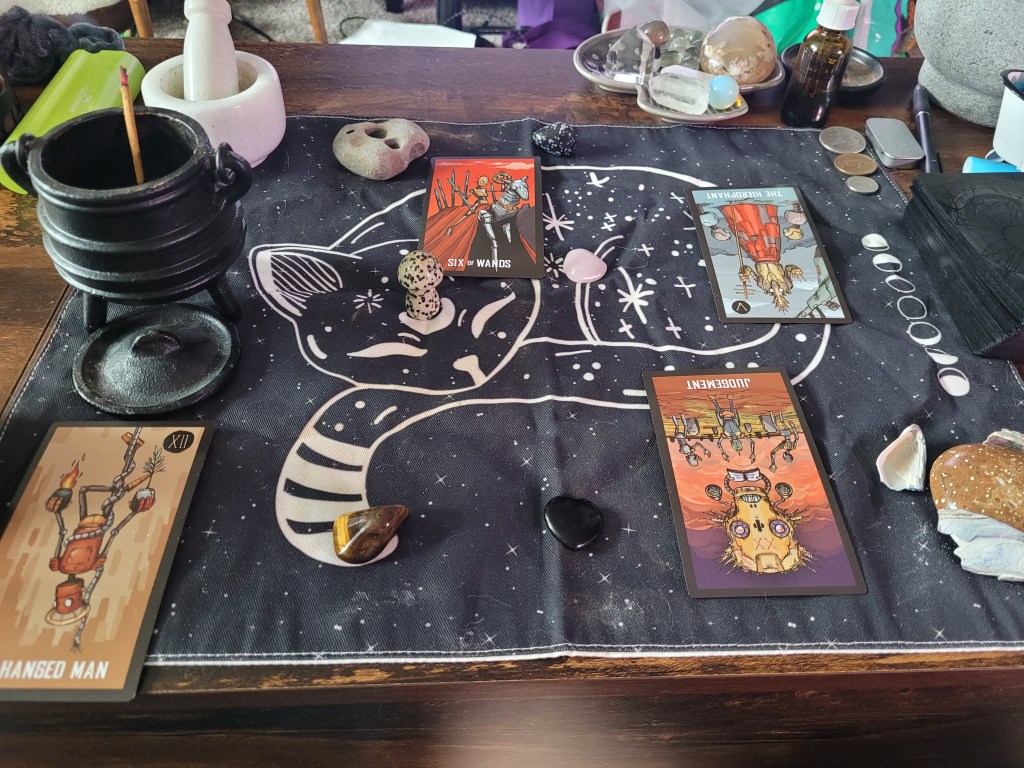
    <i> did a <reading / ritual> for her <using> one of <my> <favorite / beloveded> decks (Tarotbot black) as her <work / writing> <trailblazed> <unhuman> <narratives>, <creating> <space> for the <science fiction> <we> are familiar with today.

    it <felt> <appropriate>, the victorians <loved> the occult and there is an <interesting> <correlation/ inclusion> of <spirituality> in <science fiction> that <feels> partly like the <offspring> of the <emergence> of the <genre> and the victorian <fascination> with the occult.

    Tonight, in veneration, <my partner> and <i> will <brew> some chai and start Alien:Earth. RIP Mary, you would have loved androids.

  • July reading wrap-up

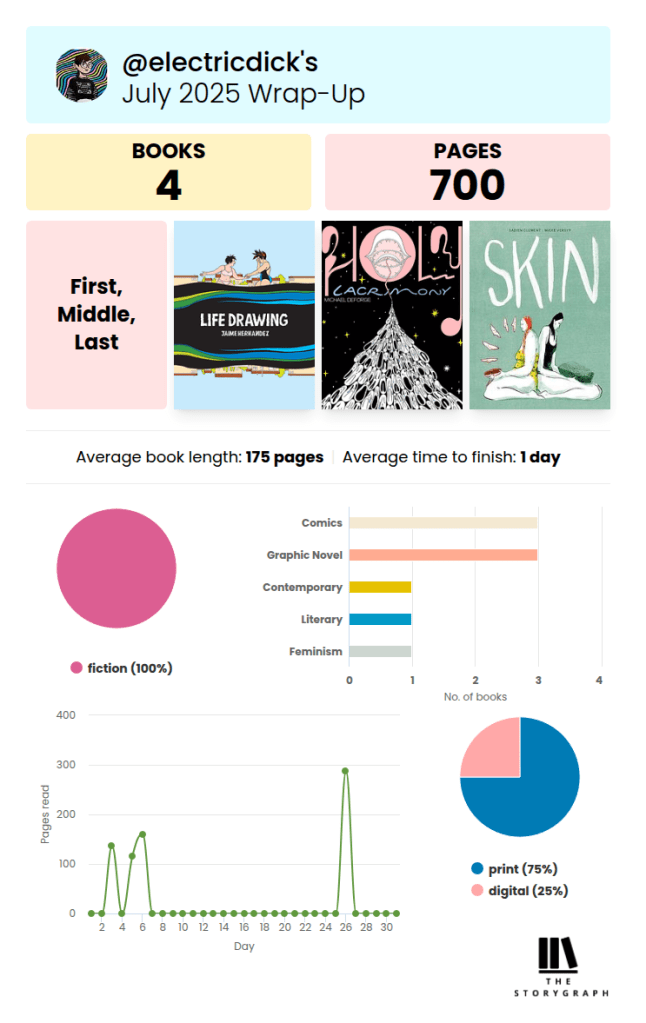
    well, it was an <unsuccessful / low quantity> <reading> month. something about july makes it an <unusually> <difficult> mental <health> month for <me>. <i> call it <my> <summertime blues>.

    <i> did get <overwhelmed> by <my> library request arriving all within a week <despite> <me> placing the hold spaced out with the <hope> that would <trickle in>. there is <something> to be <said> about <neurodivergence> and too many <choices> causing <decision making <dysfunction>>.

    but <enough> about <my> <summertime blues>, what about the <books>. <my>, albeit <unfinished> <favorite> this month was “dungeon crawler carl.” <i> had to return it to the library about <three quarters> of the way through, because holy crap is this <book> <in demand>. <i> wound up <purchasing> a <used <copy>> of the hardback with the <new> covers to <finish> it. Princess donut is the <only> monarch <i> <love>.

    “skin” and “holy Lacrimony” both had <very different> but stunning art styles. “holy lacrimony’s” exploration of <human> <emotions> through <psychedelic> <alien> art <captures / depicts> <depression / sadness> in a manner both <familiar> and <uneasy>. “skin” has a <lovely> sketch book <inspired> <style> that still manages to <convey> two whole <worlds> of <emotion> as it <follows> the <similar yet different> lives of two women decades <apart>. one of <my> <favorite> <stylistic> choices in the <book> is the way that drawn panels are often <foregone> in favor of sketching out the <characters> in stages <across> the mise-en-scène (<think> Picasso’s “nude descending a staircase”).

    and <of course> there is a <soft spot> in <my <heart>> for “life drawing.” Xaime hernandez is <my> <favorite> of the brothers both for his <style> and <stories>. <i> <adore> maggie and hopey, and <watching> them <become> middle aged is <bittersweet>. “life drawing’s” <main> characters are a <new>, <younger> group of girls, but just like <real life>, these girls are <going through> all the <same> range of <experiences> and <emotions> as maggie and hopey did. if <i> am not mistaken, the last chapter of “life drawing” even <reproduces> panels from an earlier “love and rockets” with tonta and her friends. even though <time> ticks on, <we> are <bound> <together> through <sharing> the <experiences> that <create / forge> <us>.

    for august <i> have already started with “the Kakogawa food detectives” and am <looking forward> to the new Alison Bechdel.

  • why do <you> <write> like that?

    Depends on what is <meant / intended> by “like that.” as a visual <poet> and zine <creator>, <i> <wanted / desired> a visual way to convey <uncertainty / impreciseness> in <my> <writing>. the <written> word is a beautifully imperfect way of <communicating> that <asks / requires> the <writer> to constantly be making language choices. and these choices are frequently never <perfect>. <communication can never be perfect>.

    <i> was <inspired> by a few different <philosophers / artists> to use angle brackets to <visualize / convey> uncertainty. like a good little grad school <student>, <i> read <theory>, lots and lots of <theory>. and <i> had a <<post> structuralist / deconstructionist> phase, which included plenty of Derrida and a desire for the <pursuit> of <creative> <writing> that could <visualize / verbalize> “sous rature” in <interesting / narratively productive> ways. Derrida (and yes, Heidegger is the <primary> source for this, but <i> have yet to locate a <desire> to <read> Heidegger) would <visualize> this in his own <writing> for <signifiers / words> that he <felt / believed> were “inadequate yet necessary” by <striking through / placing under erasure> the <inadequately necessary> words. <i> have <chosen / selected> the angle bracket for <my> own form of marking <erasure>. it is not a <form> of <writing> <i> always <employ / use>; <obviously> <i> don’t write like this in day-to-day correspondence and in the materials <i> create for work, and <poetry> that <i> want to send out for publication takes on a more <normal> structure. but blog posts and zines are a <adequate / appropriate> medium for <writing> in this experiential style.

    it’s also a way <i> used to express <my> own self uncertainty. <i> even wrote a zine about placing <myself> <under erasure>.

    but what about the forward slash in-between the bracketed words sometimes? <my> utilization of this was <inspired / provoked> by the translation of the board in control. in control the board is the <inter / intra> dimensional entity that the director of the federal bureau of control <answers to / get help from>. this / these entities are <incomprehensible> visually and auditorily. when they are speaking to Jessie in the game, their <garble> is translated in subtitles. But much in the way that derrida <writes> about words <containing / encompassing> both the <curse> and the <cure>, many of the phrases and words that are <translated> from the board <translate> into uncertainty which is <visualized / verbalized> in the subtitles by <displaying / offering> the <duplicating> meanings with forward slashes between them. and everything the board says is under <erasure> by already being an <interpretation> as all <translation> is, and this is <written / visualize> via the use of angle brackets. <i> don’t use it in <exactly> the same way, but <i> enjoy the <visualization> and slightly more <precision> of <visually> displaying the <words> <i> was deciding amongst, <folding / including> the multitude of <meaning> hiding in all <language>.

    there is also the additional <bonus> of <odd / funky> formatting <disrupting / disturbing> the scraping of <ai / algorithmic <<re>production>>.
  • June reading wrap-up

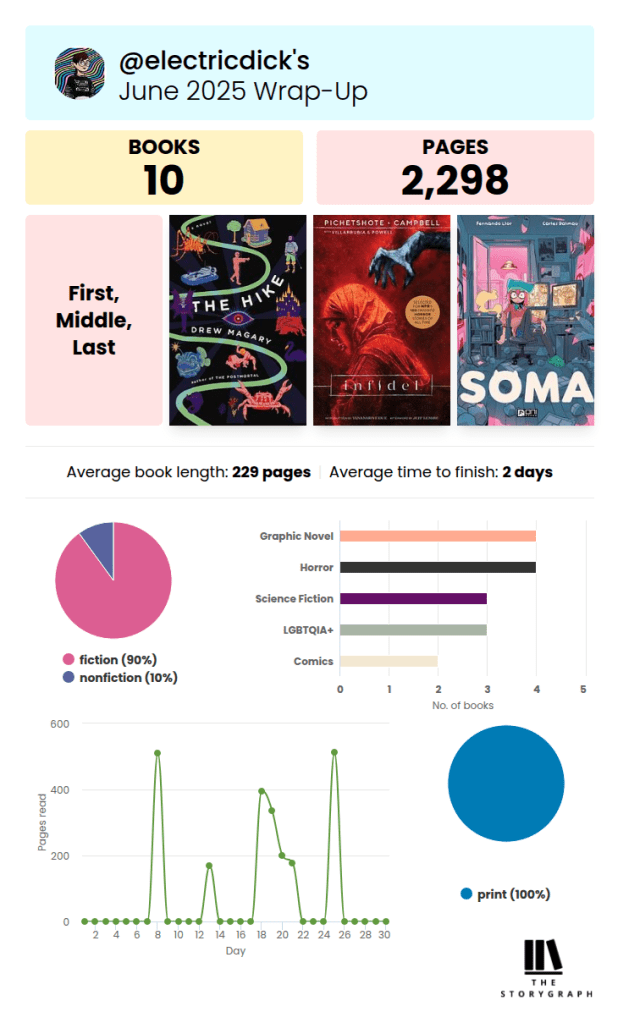
    one of <my> personal <goals / aims> this year was to <re-learn> how to read for <enjoyment / pleasure>. being in college <in one form or another> since <i> was 18 <slowly> sapped <my> desire to read for pleasure until <i> just wasn’t <doing it> anymore. this year, to get a <running start>, <i> participated in Storygraph’s January reading challenge, <reading> at least one page a day each day of the month. <i> think this help <recondition / reprogram> <my> brain to slowly <re-find> the <enjoyment / pleasure> of <text>.

    Since January, <i> have been steadily keeping it up. <not> every day <mind you>, but fairly consistently (<i> stopped tracking pages read, so <my> storygraph reading chart reflects the days <i> logged the <book / text> as <finished>). and <i> even signed up for a library card in <my> new city and have <borrowing> instead of <buying>.

    this month <my> favorite was the <archive of alternate endings>. <i> love <narratives> that tell one <story> through the telling of another, and the way the <narrative> wove everything together was <beautiful>. <i> was not expecting the through line half-way through to windup being about the aids crisis and <i> found <myself> sobbing.

    <my> least favorite was <the king in yellow>. the first four <stories> in the collection were alright. <i> do like the <mystique / unreliability> of <reality> in <cosmic horror> and <i> do realize that Robert chambers was one of the <first> to write in this genre, but for <enjoyment / pleasure> it was not as <exciting> as what <others> following chambers have done with the <mythos>. <i> would still suggest <folks> that are into <cosmic horror> read the first four <stories> to gain a historical perspective of the <emergence / evolution> of the <genre>. after the first four <stories>, the collection completely shifts genres into tales that have <little to nothing> to do with <the king yellow mythos>, and many of them are romance tales, which are not a <genre> <i> prefer to read.

    an <amusing> side story, <the house without the door> <i> read because, after years of searching, <i> thought it was the same <mystery novel> <i> had borrowed from <my> great-grandmother’s bookshelf when <i> was in middle school. <i> vaguely <remembered> the plot and the title being something about a house and door. <i> found the elizabeth daly <book> thanks to the <Preservation> efforts of <online> <archives> and assumed it was the <correct> <book>. <it> did not quite <feel> like the <book> <i> vaguely <remembered> the farther <i> got into it, but <i> kept reading anyway as a <good> <mystery> is almost never a <waste> of <time>. after finishing <it>, <i> started to doubt <my> <memory>. <maybe> this was the <book> <I> had read and <i> was <conflating / confusing> the plot with another <book / text>. as <i> logging it into storygraph however, another <mystery novel> with the same title was <suggested> in the search bar, and <my> long search for the partially <remembered> <book / text> came to an <end>. <i> ordered a cheap, used copy <online>, and after years of searching off and on, <i> will get to <indulge> in a little <nostalgia> with <the house without a door> by thomas sterling and also have been introduced to daly, a women pulp writer from the 40s.

    <looking forward> to many great reads in July, starting with the new Xaime hernandez <graphic novel> and a long awaited copy of <dungeon crawler carl> from the library.