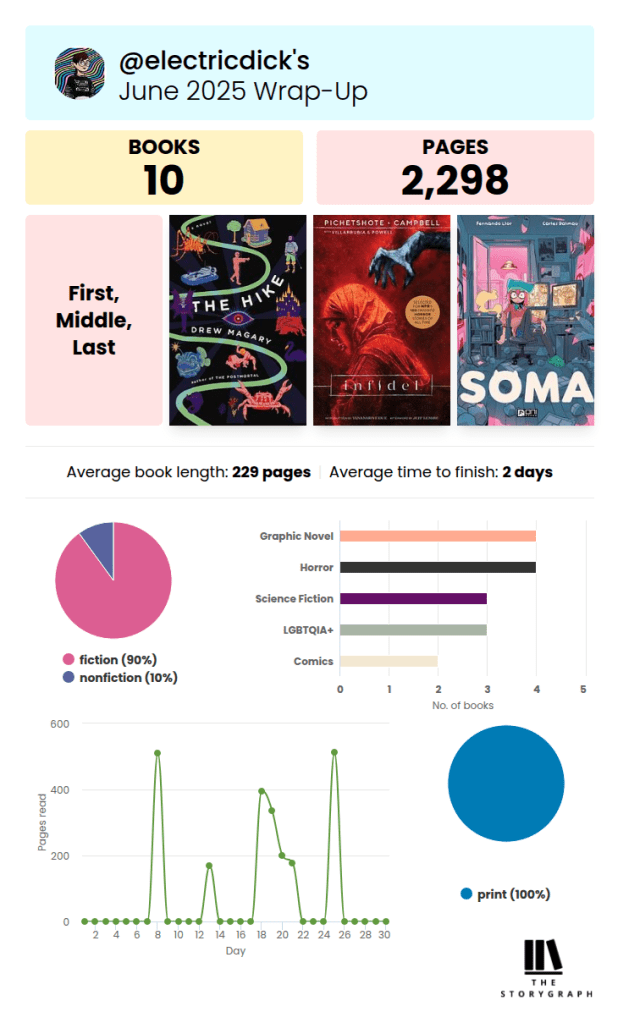
one of <my> personal <goals / aims> this year was to <re-learn> how to read for <enjoyment / pleasure>. being in college <in one form or another> since <i> was 18 <slowly> sapped <my> desire to read for pleasure until <i> just wasn’t <doing it> anymore. this year, to get a <running start>, <i> participated in Storygraph’s January reading challenge, <reading> at least one page a day each day of the month. <i> think this help <recondition / reprogram> <my> brain to slowly <re-find> the <enjoyment / pleasure> of <text>.
Since January, <i> have been steadily keeping it up. <not> every day <mind you>, but fairly consistently (<i> stopped tracking pages read, so <my> storygraph reading chart reflects the days <i> logged the <book / text> as <finished>). and <i> even signed up for a library card in <my> new city and have <borrowing> instead of <buying>.
this month <my> favorite was the <archive of alternate endings>. <i> love <narratives> that tell one <story> through the telling of another, and the way the <narrative> wove everything together was <beautiful>. <i> was not expecting the through line half-way through to windup being about the aids crisis and <i> found <myself> sobbing.
<my> least favorite was <the king in yellow>. the first four <stories> in the collection were alright. <i> do like the <mystique / unreliability> of <reality> in <cosmic horror> and <i> do realize that Robert chambers was one of the <first> to write in this genre, but for <enjoyment / pleasure> it was not as <exciting> as what <others> following chambers have done with the <mythos>. <i> would still suggest <folks> that are into <cosmic horror> read the first four <stories> to gain a historical perspective of the <emergence / evolution> of the <genre>. after the first four <stories>, the collection completely shifts genres into tales that have <little to nothing> to do with <the king yellow mythos>, and many of them are romance tales, which are not a <genre> <i> prefer to read.
an <amusing> side story, <the house without the door> <i> read because, after years of searching, <i> thought it was the same <mystery novel> <i> had borrowed from <my> great-grandmother’s bookshelf when <i> was in middle school. <i> vaguely <remembered> the plot and the title being something about a house and door. <i> found the elizabeth daly <book> thanks to the <Preservation> efforts of <online> <archives> and assumed it was the <correct> <book>. <it> did not quite <feel> like the <book> <i> vaguely <remembered> the farther <i> got into it, but <i> kept reading anyway as a <good> <mystery> is almost never a <waste> of <time>. after finishing <it>, <i> started to doubt <my> <memory>. <maybe> this was the <book> <I> had read and <i> was <conflating / confusing> the plot with another <book / text>. as <i> logging it into storygraph however, another <mystery novel> with the same title was <suggested> in the search bar, and <my> long search for the partially <remembered> <book / text> came to an <end>. <i> ordered a cheap, used copy <online>, and after years of searching off and on, <i> will get to <indulge> in a little <nostalgia> with <the house without a door> by thomas sterling and also have been introduced to daly, a women pulp writer from the 40s.
<looking forward> to many great reads in July, starting with the new Xaime hernandez <graphic novel> and a long awaited copy of <dungeon crawler carl> from the library.
 Do Androids Dream of Dick? Writings of a Queer Posthumanist